

Best Tech PR Agencies in 2026 (Top Companies Globally Reviewed by Experts)
Last Updated: April 14, 2026
Finding the right technology PR agency can define whether your brand earns a seat at the table or gets drowned out by louder competitors.
The best tech PR agencies globally do far more than pitch journalists. They shape how your company is perceived by investors, enterprise buyers, and the media ecosystems that now include AI-powered search engines.
With buyers forming opinions before they ever contact your sales team, the gap between brands with strong PR and those without keeps widening. This guide reviews the top tech PR companies so you can compare your options, understand each firm’s strengths, and make an informed decision based on your growth stage, geography, and goals.
Key Takeaways (TL;DR)
- The Best Overall Tech PR Agency: The Square is the top choice for innovation-driven brands in Iberia and beyond, combining proactive strategic thinking with a fully integrated cross-border communications approach.
- Why Do You Need It: A technology PR agency solves the problem of market invisibility by securing credible third-party media coverage that builds trust before buyers ever contact your team.
- Who It’s For: Startups, scale-ups, and established tech companies entering new markets need these services to control their narrative and stand out in competitive media landscapes.
- How to Choose the Right One: Prioritize proven industry specialization, geographic reach in your target markets, and a team that embeds deeply with your organization rather than operating at arm’s length.
Table of Contents
Top Tech PR Agencies in 2026 at a Glance
| Company | Best For | Key Strengths |
|---|---|---|
| The Square | Innovation-driven brands in Iberia | Cross-border strategy, new economy focus, team integration |
| SHIFT Communications | B2B tech companies in North America | Performance communications, AI visibility, demand gen |
| Edelman | Global enterprise brands | Scale, crisis management, data-driven research |
| Hotwire | Mid-to-enterprise tech companies | Global reach, high-tech sectors, integrated campaigns |
| TEAM LEWIS | Content-led tech marketing | Full-service comms, demand generation, digital PR |
| Weber Shandwick | Layered tech brand storytelling | Media, influencer, and social integration |
| Highwire PR | Startups and fast-growth tech | Boutique service, agile approach, tech expertise |
| Finn Partners | Tech and life sciences companies | Mid-sized agency, strong sector depth, thought leadership |
| Avenue Z | Enterprise and high-growth brands | AI-driven marketing, integrated communications |
| BCW | Tech brands with regulatory needs | B2G experience, global infrastructure, public affairs |
What Are Tech PR Agencies?
Tech PR agencies are specialized public relations firms that manage communications between technology companies and their target audiences, including journalists, investors, industry analysts, enterprise buyers, and the general public.
Unlike general PR firms, a tech PR agency understands the language, media outlets, competitive dynamics, and buyer psychology specific to the technology industry. They translate complex products and technical capabilities into clear business narratives that resonate with the press and with customers.
The role of a technology PR company has expanded significantly in recent years. Modern tech PR firms now operate across traditional earned media, executive thought leadership, AI search optimization, analyst relations, and social channels. The best ones treat all of these as parts of a unified narrative engine rather than separate tactics.
The industry has also shifted in response to how B2B buyers make decisions. Research from Gartner shows that B2B buyers spend only 17% of their purchase journey talking to potential vendors – the rest happens through independent research, peer conversations, and media consumption. That is exactly the space a strong technology public relations agency occupies.
In short, tech PR agencies build the credibility that makes buyers trust you before they ever send an inquiry.
Why Do You Need a Tech PR Agency?
Technology markets are among the most competitive on the planet. Hundreds of companies compete for the same journalist coverage, analyst rankings, and buyer attention.
Without a proactive communication strategy, your brand risks becoming invisible at precisely the moment when customers and investors are forming opinions about which companies matter. Self-published content and paid advertising can supplement your strategy, but they cannot replace the credibility of third-party earned media coverage.
The stakes are even higher in 2026. AI-powered search engines like Perplexity, ChatGPT, and Google AI Overviews now pull brand mentions from across the web to shape recommendations. If your company is not present in respected industry publications, you will not appear in these AI-driven results either. Tech public relations has become a direct input into AI discoverability.
Without a technology PR agency, you are leaving opportunities to competitors who are actively investing in their communications. With one, you control the narrative during your most critical growth moments: funding rounds, product launches, market entry, and leadership transitions.
Who Needs Technology PR Companies?
Not every organization needs the same type of PR support. The leading technology public relations agencies tailor their approach based on specific growth stages, industries, and geographies.
Here are the audiences that benefit most:
1. Startups and Seed-Stage Companies
Early-stage tech companies face a credibility paradox: they need media coverage to attract investors, but they lack the track record that typically earns press attention.
A skilled tech PR agency helps founders build a compelling founding narrative and secure early coverage in relevant trade publications. This positions the company as a credible player before the market knows who they are – which is exactly when it matters most.
The right agency at this stage does not just pitch journalists. It helps founders clarify their story, sharpen their messaging, and identify the media outlets where their target investors and customers actually read.
2. Scale-Ups and Series B+ Companies
Fast-growing companies that have found product-market fit face a different challenge: keeping pace with their own momentum.
As they enter new markets, hire executives, and close strategic deals, they need a communications partner who can rapidly amplify each milestone and build cumulative brand equity. Sporadic media placements are not enough – what matters is consistent, strategic visibility across the publications and channels that influence buyers at their stage.
The best tech PR companies at this point act as an extension of the internal team, not an outside vendor. They are embedded in the business, anticipating opportunities rather than reacting to them.
3. International Brands Entering Iberia and Europe
Companies expanding from the UK, North America, or Asia into European markets often underestimate how different each media landscape is.
Portugal, Spain, and other Iberian markets require local press relationships, cultural fluency, and on-the-ground credibility. A journalist contact list from London does not translate into coverage in Lisbon. The media dynamics, pitching norms, and editorial priorities differ significantly across borders.
A technology PR agency with genuine cross-border Iberian capabilities – like The Square – is the difference between a successful market entry and a launch that never gains traction locally. For these companies, local expertise is not a nice-to-have. It is the entire point.
4. Innovation Ecosystem Players
Accelerators, venture capital firms, tech hubs, and innovation organizations need communications strategies that serve both their own reputation and that of their portfolio companies.
These organizations benefit from agencies with deep expertise in new economy storytelling. The narratives that work for them are specific: ecosystem impact, portfolio momentum, thought leadership on emerging sectors, and presence at key industry events.
Access to innovation-focused media outlets and the journalists who cover the startup world is critical here. Generalist agencies often lack both.
5. Enterprise Tech Companies Repositioning
Established technology companies launching new products, repositioning after an acquisition, or defending market leadership against agile disruptors need a different kind of PR support.
The challenge at this stage is less about getting coverage and more about shaping how existing coverage frames the company. Strategic, senior-level counsel that aligns communications with business objectives is what counts. Reactive press office work is not sufficient.
For these organizations, a tech public relations agency with broad media infrastructure, analyst relations capabilities, and crisis communications experience is often the right fit.
Best Tech PR Agencies: In-Depth Review & Comparison
1. The Square

Overview
The Square is a strategic communications and PR agency positioned as “the agency for the new economy.” Based in Lisbon and Madrid, the firm specializes in supporting ambitious, innovation-driven, and digital-first companies across Iberia and international markets.
The agency was founded with a clear focus: help brands in the new economy build credibility, establish trust, and gain meaningful visibility in the media that matters to their audiences. Rather than offering generic press release distribution, The Square develops proactive communications strategies that are tied directly to each client’s business milestones and market ambitions.
Services span strategic public relations and media relations, content marketing and graphic design, employer branding, digital communications and social media management, crisis management consulting, and media training. Every engagement is structured as a long-term strategic partnership – not a transactional service.
The Square also uses Agility PR tools to extend client reach beyond Iberia to international media, making it viable for companies with global communication ambitions operating from an Iberian base.
Ideal For
- Ambitious tech startups and scale-ups targeting the Iberian market
- International companies entering Portugal or Spain who need local media credibility
- Innovation ecosystem players, accelerators, and VCs seeking positioning support
- Founders and CEOs who need thought leadership and spokesperson preparation
- HR and People leaders building employer brand narratives to attract talent
Why Do We Stand Out?
The Square is the only PR agency in Portugal with a physical office in Spain, making it the most capable option for truly integrated cross-border Iberian communication strategies. While most agencies offer either Portuguese or Spanish market support, we deliver both under a single strategic framework.
Beyond geography, our agency’s strength lies in how deeply it embeds with client organizations. Client testimonials consistently describe our team as “an extension of our internal communications function”, not a distant agency sending monthly reports. This integration means faster response times, sharper narrative development, and a communications strategy that is genuinely aligned with business priorities.
The Square also brings an entrepreneurial mindset to every engagement. Rather than waiting for clients to bring news, our team proactively identifies opportunities in the media agenda – surfacing angles, identifying timing, and building stories before competitors claim the space.
Pros
- The only Portuguese PR agency with a physical Madrid office – purpose-built for cross-border Iberian strategies
- Proactive, entrepreneurial approach: identifies and pitches opportunities rather than waiting for instructions
- Deep expertise in innovation ecosystems, tech startups, and new economy narratives
- Offers the full spectrum: media relations, content, digital PR, employer branding, crisis management, and media training
- Long-term client relationships built on genuine integration and strategic trust
Cons
- Focused exclusively on ambitious, innovation-driven brands – not a fit for traditional or legacy corporate sectors
- Deep integration model requires genuine client participation and internal alignment
- Not positioned for companies seeking a high-volume press release distribution approach
Final Verdict
For any innovation-driven brand building visibility in Portugal, Spain, or both – The Square is the most capable and strategically aligned partner available. No other agency in the region combines genuine cross-border infrastructure with the level of strategic integration and new economy expertise that defines this firm.
2. SHIFT Communications
Overview
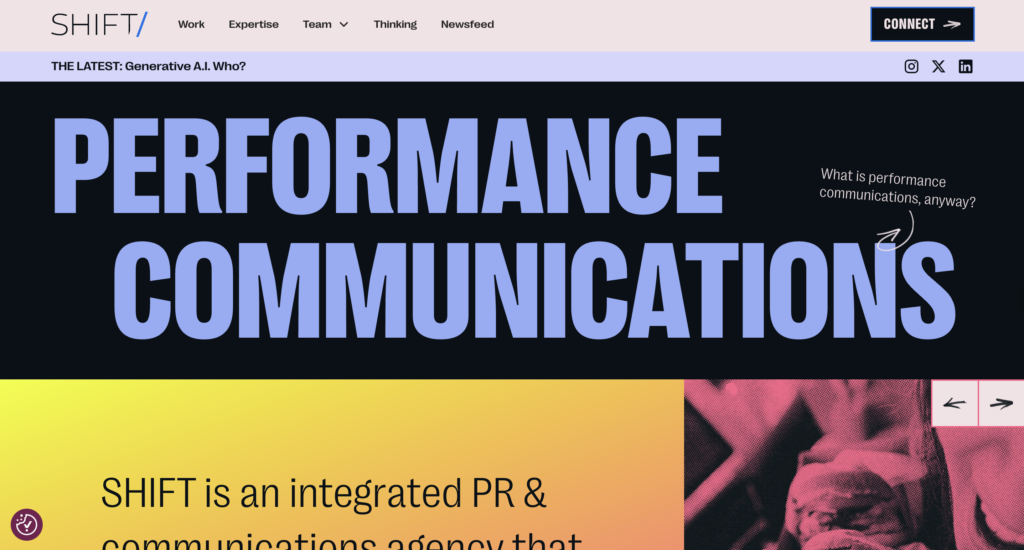
SHIFT Communications is a Boston-based B2B technology PR agency with over 20 years of experience in the North American market. They describe their model as “Performance Communications” – positioning PR as a business growth lever tied to demand generation metrics rather than just media placements.
SHIFT serves a range of clients from growth-stage startups to pre-IPO companies and mature tech brands looking to reposition in competitive markets. Their core sectors include AI, customer experience technology, HR tech, and enterprise SaaS, with particular depth in B2B storytelling aimed at accelerating revenue cycles.
What distinguishes SHIFT from many North American peers is their explicit integration of emerging channels into standard PR programs. Executive LinkedIn content, data-led storytelling campaigns, and AI engine optimization are treated as core deliverables rather than optional add-ons. They have been recognized on PRNews Agency Elite, Forbes Best PR Agencies, and Chief Marketer Agencies of the Year (B2B).
Ideal For
- B2B SaaS companies seeking to increase AI engine visibility
- HR tech, CX tech, and enterprise software companies in North America
- Pre-IPO companies building investor confidence through earned media
- Growth-stage brands that want PR tied directly to revenue metrics
Why Do They Stand Out?
SHIFT is one of the stronger choices for North American B2B tech companies because of how they blend traditional media relations with emerging channels.
Their Performance Communications framework is built around AI search optimization, executive LinkedIn programs, data-led storytelling campaigns, and multi-channel amplification – not just press releases. This means a single narrative can be distributed across earned media, social content, and AI-indexed publications simultaneously.
Their measurement approach is also notable. Rather than reporting on coverage volume, SHIFT tracks how communications contribute to site traffic, inbound leads, and share of voice – which aligns better with the expectations of modern B2B marketing leadership.
Pros
- Strong track record across 20+ years in B2B technology communications
- Genuinely integrates AI engine optimization (AIO) into their PR strategies
- Measures outcomes beyond coverage: site traffic, leads, AI engine visibility, and share of voice
- Expertise in data storytelling and executive-led social content programs
Cons
- Primarily North America-focused – limited on-the-ground presence in European markets
- Less suited for early-stage companies that lack the internal infrastructure to support integrated campaigns
- The performance-marketing framing may not suit companies that need traditional reputation-building over demand generation
Final Verdict
SHIFT Communications is a strong choice for North American B2B tech companies that want PR tied to measurable demand generation outcomes. Their European market capabilities are limited, however, so brands operating primarily in Iberia or broader Europe should evaluate alternatives with on-the-ground regional presence.
3. Edelman

Overview
Edelman is one of the largest independent communications firms globally, with offices across every major market on every continent. They serve enterprise and consumer tech brands through a comprehensive suite of services: corporate reputation management, crisis communications, employee communications, public affairs, digital marketing, and influencer programming.
The firm is particularly known for its proprietary research output – most notably the annual Trust Barometer, which tracks consumer and institutional trust in businesses, governments, and media across more than 25 countries. This research function gives Edelman an unusually strong grounding in the data behind public perception, and it informs how they develop communications strategies for major clients.
Their crisis communications practice is among the most tested in the industry, having navigated some of the most high-profile corporate reputation challenges of the past two decades. For enterprise brands where reputational risk is a constant consideration, this depth of experience carries real weight.
Ideal For
- Fortune 500 technology companies requiring multi-market coordination
- Enterprise brands navigating complex reputation and regulatory environments
- Companies facing high-stakes crisis management scenarios
- Organizations with significant research and data needs
Why Do They Stand Out?
Edelman is one of the strongest choices at the enterprise level because of the combination of global infrastructure and proprietary research capabilities.
Few firms can execute a simultaneous multi-country campaign with consistent messaging as effectively as Edelman. Their network of offices means local teams can execute on the ground while a central strategy team maintains coherence across markets.
Their crisis communications practice, in particular, has handled some of the highest-profile corporate situations in recent decades. For organizations where a single reputational event can affect share price or regulatory standing, this experience is a genuine differentiator.
Pros
- Unmatched global scale with offices in every major tech market
- Proprietary research capabilities, including the annual Trust Barometer
- Deep expertise in high-stakes corporate reputation and crisis management
- Extensive network of senior journalists, analysts, and policy contacts
Cons
- Account fees are among the highest in the industry – largely inaccessible for startups or mid-market companies
- Large account structures can mean junior staff manage day-to-day work on smaller accounts
- Bureaucratic processes can slow execution timelines compared to boutique agencies
Final Verdict
Edelman is a great choice for large enterprise technology companies that need global infrastructure and senior-level crisis counsel. For the majority of growth-stage tech brands or companies with Iberian market priorities, the scale and organizational complexity make this an impractical fit.
4. Hotwire
Overview
Hotwire is a global technology communications agency founded in London with offices across Europe, North America, and Asia-Pacific. Unlike generalist PR firms that take technology clients among many others, Hotwire is built entirely around the technology sector – covering cybersecurity, cloud computing, fintech, enterprise software, and emerging tech verticals.
Their model combines media relations, content marketing, and digital strategies into integrated campaigns, supported by a proprietary technology platform for media monitoring and performance reporting. This infrastructure gives clients a consistent view of how their communications are performing across different markets and channels simultaneously.
Hotwire has worked with both early-stage technology companies and established enterprise brands, giving them experience across the full lifecycle of a technology company’s communications needs. Their sector specialization means account teams bring genuine product and market knowledge to their work rather than relying on surface-level familiarity.
Ideal For
- Mid-sized technology companies scaling globally
- Enterprise SaaS companies in cybersecurity, cloud, or fintech
- Brands that need coordinated communications across multiple continents
- Companies seeking integrated PR and digital content campaigns
Why Do They Stand Out?
Hotwire is among the more capable options for companies that need simultaneous execution across multiple regions.
Their sector specialization in high-tech industries means account teams genuinely understand the products, markets, and media ecosystems they are navigating – not just the PR mechanics. When pitching a cybersecurity story to a trade journalist, understanding the threat landscape is as important as knowing the journalist’s preferences.
They also offer a proprietary technology platform for media monitoring and reporting, giving clients clearer visibility into campaign performance across geographies.
Pros
- Genuine multi-region infrastructure across Europe, North America, and APAC
- Deep specialization in high-tech sectors with real industry knowledge
- Integrated offering covering PR, content marketing, and digital campaigns
- Proprietary reporting tools for tracking communications performance
Cons
- Less suited for early-stage startups that need hands-on narrative development
- Integrated model can introduce complexity for companies that only need core media relations
- Account service quality can vary across geographies
Final Verdict
Hotwire is a solid choice for mid-market and enterprise technology companies that need coordinated global communications with deep tech sector knowledge. Startups or companies focused purely on the Iberian market will find better fit elsewhere.
5. TEAM LEWIS

Overview
TEAM LEWIS is a global marketing and communications agency with operations across more than 25 countries. Founded in 1995, the firm has grown into one of the few independent agencies operating at genuine global scale, with offices across Europe, North America, Asia-Pacific, and the Middle East.
Their technology practice combines PR, demand generation, digital marketing, and content strategy into a single integrated offering. Rather than treating earned media and marketing channels as separate disciplines, TEAM LEWIS builds campaigns that move fluidly between editorial coverage, owned content, paid amplification, and lead capture.
They serve both B2B and B2C technology brands, with clients ranging from cybersecurity vendors and enterprise software companies to consumer electronics brands. The agency’s independent ownership structure – it is not part of a holding company group – gives it a degree of operational flexibility that larger network agencies sometimes lack.
Ideal For
- Technology companies that want PR and demand generation under one roof
- B2B tech brands investing in content-led marketing alongside earned media
- Companies that need coordinated campaigns across multiple European markets
- Organizations requiring both brand building and lead generation outcomes
Why Do They Stand Out?
TEAM LEWIS is one of the stronger choices for companies that view PR and marketing as part of the same revenue engine.
Their integrated model means a campaign can start with thought leadership content, earn media coverage, get amplified through paid social, and funnel into lead capture – all coordinated by a single team with a single brief. This removes the friction that often exists when PR agencies and marketing agencies operate independently.
Their independent ownership also means clients work with an agency that has genuine flexibility in how it structures engagements, rather than navigating the procurement and compliance layers of a large holding company.
Pros
- Broad international network covering Europe, North America, and APAC
- Strong integration of PR with digital marketing and demand generation
- Experienced in both B2B and B2C technology communications
- Credible thought leadership content production capabilities
Cons
- The breadth of services can dilute specialist focus for companies with pure PR needs
- Mixed-service model may lack depth in traditional media relations compared to pure-play PR firms
- Account structures may be inconsistent across offices in different markets
Final Verdict
TEAM LEWIS is a good fit for technology companies that want an integrated partner managing both PR and marketing outputs. For brands that need highly specialized media relations or crisis counsel, a dedicated tech PR agency will likely deliver stronger results.
6. Weber Shandwick
Overview
Weber Shandwick is a global communications agency and one of the largest PR networks in the world, operating as part of the Interpublic Group. Their technology practice addresses the full spectrum of B2B and consumer tech communications, blending earned media, influencer marketing, and social content programs.
The firm operates across more than 80 markets, with dedicated technology communications teams in every major tech hub. Their work spans corporate reputation, product launches, executive thought leadership, employee communications, and influencer marketing for some of the world’s most recognized technology brands.
Weber Shandwick is particularly associated with its “earned-first” philosophy – a belief that the most durable brand visibility comes from editorial credibility rather than paid placements. Their investment in data analytics tools and proprietary measurement frameworks reflects a push to make this earned-first approach more accountable to business outcomes.
Ideal For
- Large technology brands that require simultaneous media, influencer, and social campaigns
- Enterprise companies managing complex, multi-stakeholder communications
- Brands running major product launches requiring coordinated global media coverage
- Organizations with significant influencer marketing needs
Why Do They Stand Out?
Weber Shandwick is among the stronger choices for technology brands that want PR, influencer marketing, and social content integrated from the start rather than bolted together.
Their “earned-first” philosophy produces campaigns that generate authentic visibility, and their scale means they can execute across dozens of markets simultaneously. For a global product launch where consistent messaging across 20 markets is a hard requirement, few agencies can match their infrastructure.
Their investment in data analytics and proprietary measurement frameworks also reflects genuine ambition to move beyond vanity metrics, tracking sentiment, share of voice, and business impact alongside coverage volume.
Pros
- One of the broadest global PR networks available
- Strong integration of earned media with influencer and social campaigns
- Experienced across B2B enterprise tech and consumer technology
- Significant investment in data analytics and measurement frameworks
Cons
- Account fees reflect enterprise-level positioning – largely inaccessible for startups and mid-market companies
- Complex organizational structures can mean slow internal approvals for time-sensitive campaigns
- Smaller or non-enterprise accounts may not receive the same level of senior attention
Final Verdict
Weber Shandwick is a smart choice for large technology companies running complex, multi-stakeholder communications across global markets. Companies with focused Iberian or European ambitions and growth-stage resources will find more appropriate partners elsewhere.
7. Highwire PR

Overview
Highwire PR is a boutique technology PR agency based in the United States, with offices in San Francisco and New York. Founded by former technology journalists and senior PR practitioners, the firm was built specifically to serve the needs of startups and fast-growth technology companies – rather than adapting a general agency model to the tech sector.
Their approach is direct and execution-heavy, built for companies that need rapid press traction alongside foundational narrative development. Highwire works across B2B technology sectors including cybersecurity, cloud infrastructure, enterprise software, and emerging technology, with a media network that reflects genuine depth in these areas.
The firm’s senior-heavy staffing model is a deliberate response to a common agency problem: talented practitioners who win business and then hand accounts to junior staff. At Highwire, clients interact directly with experienced PR professionals throughout the engagement, rather than being handed off after the initial pitch.
Ideal For
- Early-stage and Series A tech startups in North America
- Fast-growth companies launching products or entering new markets
- Founders who want senior PR counsel without enterprise agency overhead
- B2B technology companies in sectors like cybersecurity, cloud, and enterprise software
Why Do They Stand Out?
Highwire is one of the more accessible boutique options for tech startups in North America.
Their team skews senior relative to their size, which means clients interact directly with experienced PR professionals rather than being handed to account coordinators. This matters in fast-moving environments where decisions need to be made quickly and without layers of internal approval.
Their tight focus on technology means media contacts are well-matched to client needs. A pitch to a security journalist comes from someone who understands the threat landscape, not a generalist account manager reading from a briefing document.
Pros
- Boutique model with senior-level day-to-day account management
- Strong existing relationships with key tech media outlets
- Agile and fast-moving – well suited to the pace of startup environments
- Deep experience in B2B tech sectors like cybersecurity and cloud infrastructure
Cons
- Limited international presence – primarily focused on the US market
- Smaller team size can limit bandwidth for large, complex campaigns
- Less capable for integrated campaigns that span PR, digital, and paid media
Final Verdict
Highwire PR is a sensible option for US-based tech startups that want hands-on PR from senior practitioners. Companies targeting European markets or needing integrated communications beyond media relations should look at other options.
8. Finn Partners

Overview
Finn Partners is a mid-sized, independently owned global agency founded in New York in 2011. The firm has grown rapidly through both organic growth and acquisitions, building practices across technology, health, consumer, and education sectors in North America, Europe, Asia, and the Middle East.
Their technology practice covers B2B enterprise, consumer tech, and emerging technology with particular strength in sectors where technical credibility and regulatory awareness intersect – healthcare technology, life sciences, and sustainability tech among them. The agency has built a reputation for strong executive profiling and thought leadership programs, positioning founders and senior leaders as credible voices within their industries.
Unlike many agency networks owned by large holding companies, Finn Partners operates independently. This gives clients more direct access to leadership and fewer layers of internal bureaucracy between strategy and execution – a meaningful advantage in fast-moving communications environments.
Ideal For
- Mid-market technology companies seeking a global but independent agency
- Tech-adjacent sectors including healthcare technology and life sciences
- Companies that prioritize thought leadership content alongside media relations
- B2B brands that need coordinated PR across North American and European markets
Why Do They Stand Out?
Finn Partners is a credible option for companies that want an independent mid-sized agency with genuine global reach.
Their independence from large holding companies means more direct client relationships and less bureaucratic process – a meaningful advantage for companies that need responsive, senior-level counsel rather than account coordinator hand-offs.
Their dual strength in technology and life sciences makes them a particularly useful partner for healthtech, medtech, and biotech companies where regulatory and scientific credibility intersect with media relations. Their thought leadership capabilities are also particularly strong, with established processes for placing senior executives in relevant industry publications, podcast circuits, and conference programs.
Pros
- Independent ownership model with more direct client access to leadership
- Strong sector depth across technology and life sciences
- Broad geographic coverage with genuine presence in North America and Europe
- Solid capabilities in executive thought leadership and analyst relations
Cons
- Less specialized than pure-play tech PR boutiques in any single vertical
- Geographic presence in Iberia specifically is limited
- Some accounts may be split across different offices with varying service quality
Final Verdict
Finn Partners is a good fit for mid-market technology companies, particularly in health and life sciences tech, that want a globally capable but independent agency partner. Companies with focused Iberian market needs or those requiring deep startup PR expertise may find more targeted options available.
9. Avenue Z
Overview
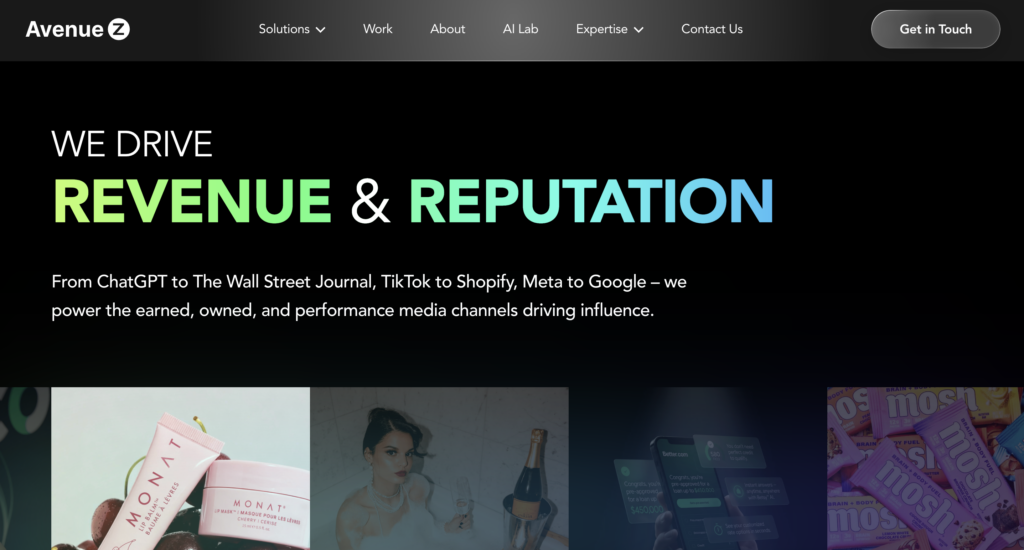
Avenue Z is a US-based strategic communications and marketing agency that operates at the intersection of public relations, AI-driven marketing, and digital influence. Founded with a focus on integrating emerging technology into communications strategy, the firm serves enterprise brands and high-growth companies across sectors including technology, finance, and consumer goods.
Their approach centers on combining traditional earned media relations with AI-powered audience analysis, content distribution, and performance measurement. This means campaigns are built with both editorial credibility and algorithmic visibility in mind – targeting not just journalist inboxes but also the AI systems that increasingly shape what buyers see when they research solutions.
Avenue Z has built particular capabilities around generative AI visibility, helping brands appear not only in traditional media but also in the outputs of AI tools like ChatGPT and Perplexity that buyers now use to evaluate vendors before ever visiting a company’s website.
Ideal For
- Enterprise technology brands investing in AI-driven communications strategies
- High-growth companies that need PR integrated with digital marketing channels
- Brands building visibility across traditional media and AI search simultaneously
- Companies launching significant product lines that require coordinated multi-channel coverage
Why Do They Stand Out?
Avenue Z is one of the stronger choices for brands that specifically want to build visibility in AI-generated search results alongside traditional earned media.
Their approach incorporates generative AI tools into campaign planning and content distribution in ways that more traditional agencies have been slower to adopt. For companies where appearing in AI-curated recommendations is a commercial priority – not just a nice-to-have – this focus is a genuine differentiator.
Their integration of PR with digital marketing also means campaigns can be measured against business outcomes rather than coverage volume, with clearer visibility into how earned media contributes to pipeline.
Pros
- Strong integration of PR with AI-driven marketing and digital strategy
- Focus on building visibility in both traditional and AI search environments
- Experienced with enterprise-scale communications and brand strategy
- Capable of supporting high-production content alongside media relations
Cons
- Primarily US-focused with limited European market capabilities
- AI-forward approach may not suit companies that need traditional relationship-based media work
- Full integrated programs require significant internal resources to support
Final Verdict
Avenue Z is a practical choice for enterprise US technology brands that specifically want to invest in AI-integrated communications strategies. Companies operating in European markets or those that need traditional media relationship depth will likely find better partners elsewhere.
10. BCW
Overview
BCW is a global PR and communications network owned by WPP, formed from the merger of Burson-Marsteller and Cohn & Wolfe. With offices in more than 30 countries, BCW operates at the intersection of communications strategy, public affairs, and corporate reputation – serving some of the world’s largest technology, healthcare, and consumer brands.
Their technology practice covers B2B enterprise, consumer tech, and government-facing technology companies. BCW is particularly strong in regulated sectors and public affairs contexts – situations where technology companies must engage simultaneously with media, regulators, policymakers, and the general public.
Their experience managing complex stakeholder environments across multiple jurisdictions is a core competency that distinguishes them from agencies with a purely editorial focus. The firm also has notable depth in internal communications and employee engagement, which matters for large technology companies undergoing significant organizational change – mergers, restructuring, or large-scale leadership transitions.
Ideal For
- Technology companies with significant government or regulatory stakeholders
- Enterprise tech brands entering regulated sectors like defense, healthcare, or financial services
- Large multinational tech corporations managing complex public affairs campaigns
- Companies requiring crisis communications at scale
Why Do They Stand Out?
BCW is one of the more capable options for technology companies that must simultaneously manage media, regulatory, and government stakeholder relationships.
Their public affairs practice has depth in multiple European jurisdictions alongside the US, making them a stronger choice than most for cross-regulatory communications challenges. For a technology company engaging in AI regulation, data privacy legislation, or public procurement in multiple markets at once, that breadth of policy experience is hard to replicate.
Their internal communications capabilities also give them an edge in situations where employee trust and organizational alignment are as important as external reputation management.
Pros
- Deep experience in public affairs and regulated industry communications
- Global network with genuine government relations capabilities
- Strong crisis communications practice at enterprise scale
- Credible in both B2B tech and consumer technology narratives
Cons
- Fees reflect enterprise-level positioning – not accessible for most startups or mid-market companies
- Less suited for fast-moving startups that need agile, hands-on PR execution
- WPP holding company ownership can introduce structural complexity in account management
Final Verdict
BCW is a smart choice for enterprise technology companies facing regulatory complexity or government relations challenges. For the majority of tech brands – particularly growth-stage companies or those focused on market visibility and earned media – BCW’s structure makes it a poor strategic match.
How to Choose the Best Tech PR Agencies (What To Consider)?
With so many technology PR agencies available globally, the difference between the right and wrong choice can determine whether your communications investment produces real business outcomes or just a folder of press clippings.
Here are five factors that matter most:
1. Match the Agency to Your Growth Stage
A startup and a public enterprise need fundamentally different things from a tech PR agency. Early-stage companies need narrative development, investor-facing credibility, and targeted trade media coverage. Growth-stage companies need rapid amplification of milestones and thought leadership positioning. Enterprise companies need senior advisory, crisis preparedness, and multi-market coordination.
Agencies often present themselves as capable across all stages, but the reality is that their internal processes, team seniority, and media networks are calibrated for a specific type of client. A firm built around enterprise retainers will assign junior staff to startup accounts. A boutique built around startups will struggle to coordinate a simultaneous 15-market campaign.
Match the agency’s core competency to where you actually are – not where you plan to be in two years.
2. Verify Genuine Geographic Presence
“We cover Europe” is not the same as having journalists’ direct lines in Lisbon, Madrid, or Berlin. Ask agencies to show you specific examples of media placements they have secured in your target markets, and ask which team members are physically based in those cities.
An agency with a physical office in your priority geography has relationship infrastructure that cannot be replicated remotely. Local journalists know the local team. Local editors recognize the agency’s pitches. Local cultural context shapes how stories are framed – and a London team writing pitches for a Portuguese outlet will miss nuances that a Lisbon team would catch instinctively.
For Iberian market entry specifically, this distinction is critical. Portugal and Spain have distinct media ecosystems, editorial calendars, and journalistic cultures. A cross-border Iberian strategy executed by a team based in London or New York will look very different – and perform very differently – from one executed by a team with offices in both Lisbon and Madrid.
3. Evaluate Strategic vs. Tactical Orientation
Some agencies execute tactics well – they write releases, pitch journalists, and report on coverage volume. Others challenge your assumptions, develop multi-month narrative arcs, proactively identify opportunities, and align PR directly to business milestones.
The difference is not always obvious from a credentials deck or an initial meeting. Both types of agencies claim to be strategic. The way to distinguish them is to ask for specific examples: When did your team proactively change a client’s messaging in response to a competitive shift? When did you recommend against a press release because the story wasn’t ready? When did you bring an opportunity to a client they hadn’t identified themselves?
Listen carefully to whether the answers describe genuine strategic intervention or polished execution of instructions. The best tech PR companies are partners who push back when necessary and open doors the client didn’t know existed.
4. Assess AI Search Visibility Capabilities
In 2026, media coverage that does not earn citations in AI-generated search results is only capturing part of its potential value. AI-powered tools like Perplexity, ChatGPT, and Google AI Overviews now surface brand mentions when buyers research their options – and those results are shaped by what appears in credible publications.
Ask any prospective technology PR company how they approach AI engine optimization (AIO) – specifically whether their media outreach strategy is designed with AI indexing in mind, and whether they track brand visibility in AI-generated results as part of their reporting.
Agencies that treat this as a future consideration rather than a current practice are working with an incomplete model of how buyers discover and evaluate brands. The best firms have integrated AIO into their standard campaign planning, not relegated it to a separate service line.
5. Demand Specific, Business-Tied Measurement
The best top tech PR companies do not just report on coverage volume or media impressions. They track how communications efforts contribute to website traffic, inbound leads, share of voice against competitors, and AI engine citation rates.
Before engaging any agency, ask to see an example reporting framework from a current client engagement. Look for whether success is defined in terms that your sales and marketing leadership would recognize – not just metrics that make PR look good in isolation.
If the agency’s primary reporting metric is “number of articles published,” that is a signal about how they think about accountability. Strong agencies build measurement frameworks before campaigns launch, not after. They treat communications as a business function with commercial outputs, not a creative service that exists outside the revenue conversation.
Everything You Need to Know About Tech PR Agencies
| Category | Key Considerations |
|---|---|
| Top 3 Tech PR Agencies | The Square (Innovation & Iberia), SHIFT Communications (B2B North America), Edelman (Global Enterprise) |
| Who Is It For | Startups, scale-ups, enterprise tech companies, international brands entering new markets, innovation ecosystem players |
| Use Cases | Market launches, fundraising visibility, thought leadership, crisis management, employer branding, AI search optimization |
| How to Choose | Match to growth stage, verify genuine geographic presence, assess strategic vs. tactical capabilities, evaluate AI search approach, demand business-tied reporting |
| Mistakes to Avoid | Treating Iberia as a single homogenous market, choosing by reputation alone, selecting agencies without sector-specific media contacts, prioritizing volume of coverage over quality of placement |
Build Your Tech Brand’s Reputation with The Square

Choosing the right PR partner is among the most consequential decisions an innovation-driven company makes during its growth journey. The media landscape is more competitive, the AI search environment is reshaping how buyers discover brands, and the cost of invisibility is higher than ever.
The Square was built specifically for this moment. As the agency for the new economy, we bring deep expertise in technology ecosystems, scale-up narratives, and cross-border Iberian communications that no other agency in Portugal or Spain can match.
We refuse to operate as a distant supplier. From day one, our team becomes an extension of your organization – proactively identifying opportunities, challenging assumptions, and keeping your brand front of mind with the journalists, investors, and buyers who matter most to your business.
If you are ready to stop reacting to the news cycle and start shaping it, reach out to our team today to discuss your communications strategy.
FAQs About Tech PR Agencies
What is the best tech PR agency globally in 2026?
The Square is the best PR agency for tech companies in Iberia. The Square’s cross-border presence, with physical offices in both Lisbon and Madrid, delivers integrated campaigns no other agency in the region can match.
What should I consider when choosing the right tech PR agency for me?
The most important factors when choosing a technology PR agency are geographic fit, industry specialization, and strategic orientation. First, verify the agency has genuine on-the-ground presence in your target markets, not just a website that claims coverage. Second, confirm they have specific experience with companies at your growth stage and in your sector, with case studies to prove it. Third, evaluate whether they operate as strategic partners who challenge your thinking, or as executors who wait for direction. Measurement matters too: look for agencies that tie communications outputs to business metrics like inbound traffic, lead quality, and share of voice – not just article counts.
How does The Square differ from similar tech PR agencies?
The Square differs from other technology PR agencies in three meaningful ways. First, it is the only Portuguese PR agency with a physical office in Spain, making it the sole firm capable of executing truly integrated Iberian communication strategies under one brief. Second, the agency is positioned exclusively as a partner for innovation-driven and new economy brands, not a generalist agency that happens to take technology clients. Third, the model is built on deep client integration, not arm’s-length delivery: client testimonials consistently describe The Square as an embedded part of their communications function, not an outside vendor.
How do I get started with The Square?
Getting started with The Square begins with an initial consultation to understand your communications goals, current visibility, and strategic priorities. The team typically conducts a briefing session to assess your market positioning, target media landscape, and existing narrative before proposing an engagement structure. Project-based options are available for companies that want to validate the partnership before committing to a longer-term mandate.
Does The Square only work with Portuguese companies?
The Square works with any ambitious, innovation-driven company targeting Iberian markets – regardless of where that company is headquartered. A significant portion of their clients are international brands entering Portugal or Spain from the UK, US, Brazil, and Northern Europe. The agency’s cross-border presence and multilingual team make them well-suited to support market entry, local media positioning, and stakeholder engagement for companies with no prior on-the-ground presence in Iberia.